Lake County Dog Registration Information
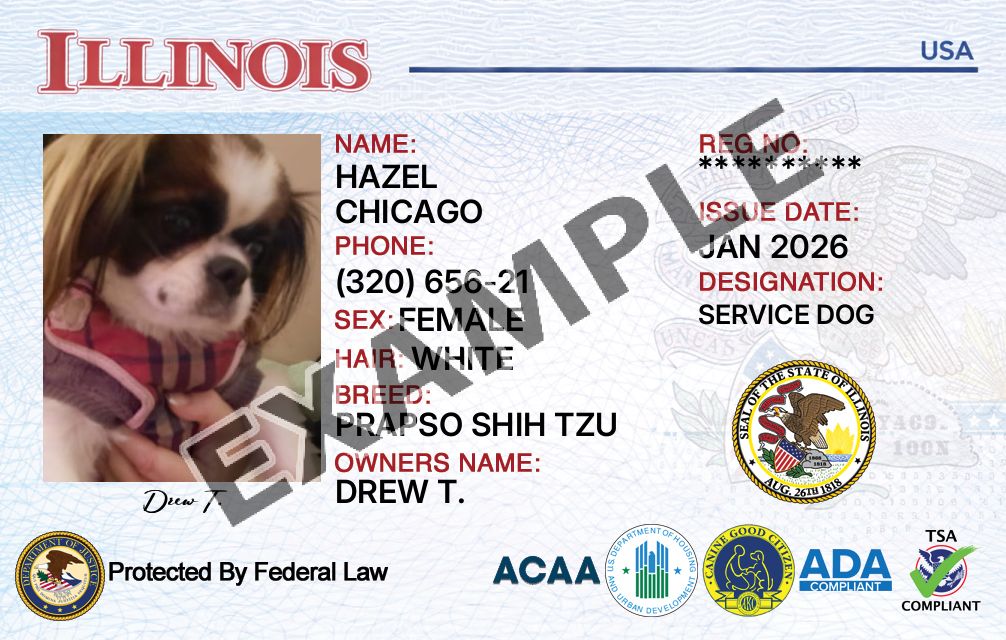
Service Dogs and Emotional Support Animals in Lake, Illinois
Registering a Dog in Lake County, Illinois (Service Dog or Emotional Support Dog)
If you’re searching where do I register my dog in Lake County, Illinois for my service dog or emotional support dog, the key detail is this: legal “service dog” status and “emotional support animal” (ESA) status are not created by a county registration. In Lake County, registration and licensing are primarily about rabies vaccination compliance and local animal control rules. Depending on where you live, you may need (1) a dog license in Lake County, Illinois through your city/village/township, and/or (2) a county-issued rabies registration tag through the Lake County Health Department’s Animal Care & Control program.
Important: Licensing vs. Service Dog / ESA Status
Getting an animal control dog license in Lake County, Illinois (or a local city/village dog license) typically confirms your dog meets public health rules (especially rabies). It does not “certify” your dog as a service animal or emotional support animal.
This page focuses on where to register a dog in Lake County, Illinois using official government offices and explains how licensing interacts with service dogs and ESAs.
Where to Register or License Your Dog in Lake County, Illinois
In Lake County, dog registration commonly involves a rabies registration tag through the county animal control/rabies control program, while dog licensing is often handled locally by the city, village, or township where you live. The official offices below are examples of places residents commonly contact to ask where to register a dog in Lake County, Illinois. Bring your address to confirm the correct jurisdiction and requirements for your specific municipality.
County Rabies Registration / Animal Control (Primary County Office)
| Office | Lake County Health Department & Community Health Center — Animal Care and Control |
|---|---|
| Address | 18736 W Peterson Road, Libertyville, IL 60048 |
| Phone | 847-377-4700 |
| animalcontrol@lakecountyil.gov | |
| Office Hours | Monday–Friday: 8:30 a.m.–5 p.m.; Saturday: 8:30 a.m.–1 p.m. |
| Notes | Warden on call 24 hours via the main phone number (emergencies). |
Example Local Office (City)
City of Waukegan (Contact / Animal Control)
- Address: 100 N Martin Luther King Jr. Avenue
- City/State/ZIP: Waukegan, IL 60085
- Phone: 847-599-2500
- Email: Not listed on the referenced page
- Office Hours: Monday–Friday: 8 a.m.–5 p.m. (except legal holidays)
Example Local Office (Village)
Village of Lake Bluff (Village Hall / Animal Control Info)
- Address: 40 E. Center Avenue
- City/State/ZIP: Lake Bluff, IL 60044
- Phone: (847) 234-0774
- Email: Not listed on the referenced page
- Office Hours: Monday–Friday: 8:00 a.m.–4:30 p.m.
- Note: Lake Bluff indicates it contracts with the Lake County Health Department for animal and rabies control services.
Example Local Office (Township Resource)
Lake Villa Township (Stray Animals / Rabies & Licensing Guidance)
Lake Villa Township publishes guidance noting that dogs/cats 4 months and older must be vaccinated for rabies and licensed within the county, and that registrations can be obtained through a veterinarian issuing the vaccine or through the county Animal Care & Control program. Street address, phone, email, and office hours were not provided on the referenced guidance page.
Overview of Dog Licensing in Lake County, Illinois
What “Registration” Usually Means in Lake County
In many parts of Lake County, “registering” a dog refers to obtaining a rabies registration tag connected to a record maintained by the county’s animal control/rabies control program. The Lake County Animal Care & Control program describes its role as preventing the spread of rabies, supporting a database of registered dogs and cats, and enforcing county ordinances and state animal-related laws.
What a “Dog License” Usually Means
A dog license in Lake County, Illinois can mean different things depending on your municipality:
- Some municipalities issue their own annual license (often tied to local ordinances, fees, and local tag/sticker programs).
- Some municipalities rely on the county rabies registration tag rather than issuing a separate city/village license.
- Enforcement, reporting stray animals, and nuisance complaints may be handled by local police departments, local animal control, or the county animal control program, depending on contracts and local rules.
How Dog Licensing Works Locally in Lake County, Illinois
Step 1: Confirm Your Local Jurisdiction
Lake County includes many cities, villages, and townships. That’s why the answer to where to register a dog in Lake County, Illinois is often: it depends on your address. Your municipality may:
- Require a local license/tag/sticker purchased through a village or city office,
- Direct residents to the county for rabies registration tags, or
- Use a combination (county rabies registration plus local licensing).
Step 2: Get (and Keep) Rabies Vaccination Current
Rabies vaccination is the foundation of local licensing programs and rabies enforcement. Lake County guidance published by local government sources indicates that dogs (and cats) at or above a certain age threshold must be inoculated against rabies and licensed/registered within the county they reside. Your veterinarian is commonly involved because rabies vaccination records are often required to obtain a tag or license.
Step 3: Obtain Your Tag/License Through the Correct Office
Depending on where you live, you may obtain registration or tags:
- Through your veterinarian when the rabies vaccination is issued (some jurisdictions allow this pathway),
- Through Lake County Animal Care & Control (county rabies registration/tag), and/or
- Through your local municipal office (city/village licensing program, if applicable).
Rabies Rules and Why They Matter for Licensing
Rabies rules protect public health and drive how “animal control dog license Lake County, Illinois” programs work in practice. Even if your dog is a service dog or emotional support animal, local rabies and animal control requirements still apply. In other words: a service dog is not exempt from public health requirements like rabies vaccination and local animal control regulations.
Service Dog Laws in Lake County, Illinois
What Makes a Dog a “Service Animal”
Under the Americans with Disabilities Act (ADA), a service animal is a dog that is individually trained to do work or perform tasks for a person with a disability. The work or tasks must be directly related to the person’s disability.
You Usually Do Not “Register” a Service Dog With the County
If you’re asking where do I register my dog in Lake County, Illinois for my service dog, it helps to separate two ideas:
- Service dog legal status comes from the dog’s task training and the handler’s disability-related need—not from a county registry or “certificate.”
- Local licensing/rabies registration is a separate requirement that can still apply to service animals.
Public Access Basics (What Businesses Can Ask)
In many public settings covered by the ADA, staff generally cannot require documentation, special ID cards, or training papers for a service dog. Instead, they may be limited to asking specific questions (for example, whether the dog is required because of a disability and what work/task the dog has been trained to perform), while still being able to address behavior and safety issues. Regardless of public access rights, keep your dog’s rabies and local licensing current to avoid preventable conflicts.
Emotional Support Animal Rules in Lake County, Illinois
What an Emotional Support Animal Is (and Isn’t)
An emotional support animal (ESA) is generally an animal that provides emotional support that alleviates one or more identified effects of a person’s disability. ESAs are commonly addressed in housing contexts as a reasonable accommodation to pet restrictions. However, ESAs are typically not considered service animals under the ADA and generally do not have the same public access rights.
Do You Register an ESA With Lake County?
If you’re asking where do I register my dog in Lake County, Illinois for my emotional support dog, the practical answer is: you typically do not register an ESA with the county to “make it official.” What you may need instead depends on the setting:
- Housing: you may need to request a reasonable accommodation from your housing provider (and provide reliable disability-related information if your disability or the disability-related need isn’t obvious).
- Licensing/rabies: your ESA still generally needs to meet the same local licensing and rabies requirements as any other dog.
Avoid Confusing ESA “Letters” With Licensing
Even if you have documentation supporting an ESA accommodation for housing, that is separate from your dog license in Lake County, Illinois and separate from any animal control dog license Lake County, Illinois processes. Think of it as two lanes: housing accommodation on one side and public health/local compliance (rabies + local licensing) on the other.
Frequently Asked Questions
Service dog
A dog individually trained to perform disability-related work or tasks. Service dogs often have public access rights under the ADA (with behavior and safety requirements).
Emotional support animal (ESA)
An animal that provides emotional support that alleviates effects of a disability, commonly addressed in housing as a reasonable accommodation. ESAs generally do not have the same public access rights as service dogs.
Pet
A companion animal without disability-task training or a disability-related accommodation basis. Pets must still follow local licensing and rabies rules.
What You May Need
- rabies vaccination proof
- identification
- proof of residency
- licensing fee
Quick Guidance for Lake County Residents
If your goal is compliance (and peace of mind), focus on two things:
- Rabies compliance: keep vaccination current and ensure your dog has the appropriate tag/registration.
- Local rules: confirm whether your city or village requires a separate license in addition to the county rabies registration.
Register A Dog In Other Illinois Counties
Select your county below to get started with your dog’s ID card. Requirements and license designs may vary by county, so choose your location to see the correct options and complete your pup’s registration.
- Adams County Dog Registration
- Alexander County Dog Registration
- Bond County Dog Registration
- Boone County Dog Registration
- Brown County Dog Registration
- Bureau County Dog Registration
- Calhoun County Dog Registration
- Carroll County Dog Registration
- Cass County Dog Registration
- Champaign County Dog Registration
- Christian County Dog Registration
- Clark County Dog Registration
- Clay County Dog Registration
- Clinton County Dog Registration
- Coles County Dog Registration
- Cook County Dog Registration
- Crawford County Dog Registration
- Cumberland County Dog Registration
- DeKalb County Dog Registration
- DeWitt County Dog Registration
- Douglas County Dog Registration
- DuPage County Dog Registration
- Edgar County Dog Registration
- Edwards County Dog Registration
- Effingham County Dog Registration
- Fayette County Dog Registration
- Ford County Dog Registration
- Franklin County Dog Registration
- Fulton County Dog Registration
- Gallatin County Dog Registration
- Greene County Dog Registration
- Grundy County Dog Registration
- Hamilton County Dog Registration
- Hancock County Dog Registration
- Hardin County Dog Registration
- Henderson County Dog Registration
- Henry County Dog Registration
- Iroquois County Dog Registration
- Jackson County Dog Registration
- Jasper County Dog Registration
- Jefferson County Dog Registration
- Jersey County Dog Registration
- Jo Daviess County Dog Registration
- Johnson County Dog Registration
- Kane County Dog Registration
- Kankakee County Dog Registration
- Kendall County Dog Registration
- Knox County Dog Registration
- LaSalle County Dog Registration
- Lawrence County Dog Registration
- Lee County Dog Registration
- Livingston County Dog Registration
- Logan County Dog Registration
- Macon County Dog Registration
- Macoupin County Dog Registration
- Madison County Dog Registration
- Marion County Dog Registration
- Marshall County Dog Registration
- Mason County Dog Registration
- Massac County Dog Registration
- McDonough County Dog Registration
- McHenry County Dog Registration
- McLean County Dog Registration
- Menard County Dog Registration
- Mercer County Dog Registration
- Monroe County Dog Registration
- Montgomery County Dog Registration
- Morgan County Dog Registration
- Moultrie County Dog Registration
- Ogle County Dog Registration
- Peoria County Dog Registration
- Perry County Dog Registration
- Piatt County Dog Registration
- Pike County Dog Registration
- Pope County Dog Registration
- Pulaski County Dog Registration
- Putnam County Dog Registration
- Randolph County Dog Registration
- Richland County Dog Registration
- Rock Island County Dog Registration
- Saline County Dog Registration
- Sangamon County Dog Registration
- Schuyler County Dog Registration
- Scott County Dog Registration
- Shelby County Dog Registration
- St. Clair County Dog Registration
- Stark County Dog Registration
- Stephenson County Dog Registration
- Tazewell County Dog Registration
- Union County Dog Registration
- Vermilion County Dog Registration
- Wabash County Dog Registration
- Warren County Dog Registration
- Washington County Dog Registration
- Wayne County Dog Registration
- White County Dog Registration
- Whiteside County Dog Registration
- Will County Dog Registration
- Williamson County Dog Registration
- Winnebago County Dog Registration
- Woodford County Dog Registration